An MSP should charge whatever price clears its fully loaded per-seat cost at the gross margin the business needs to survive, and for most US MSPs that lands the full-managed seat somewhere around $200 to $250 per user per month, with lighter entry tiers starting closer to $90 to $185. But the number is the output, not the input. If you set a seat price by copying a competitor or guessing what the market will bear, you are pricing blind. The right way is to build the price from the bottom up: add up what one seat actually costs you to serve, decide the margin you need, and let the arithmetic hand you a floor. Everything above that floor is a commercial decision. Everything below it is a slow way to go out of business.
I spent a decade in investment banking and private equity on transactions north of $7bn, and I now run growth inside managed services and B2B service businesses. The thing that jumps out from the buyer's side of the table is how many owners cannot answer a simple question: what does one seat cost you to deliver, all in? Without that number, a per-seat price is a guess, and a guess is what gets repriced in a quality-of-earnings review or exposed the first time a big client leaves and the margin was never really there. This piece walks the unit economics: cost stack, margin target, seat price, with a labeled worked example and our own pricing data to sanity-check where you land.
Build the price from your cost, not your competitor's
The most common way MSPs set a seat price is to look sideways: what is the shop down the road charging, what did the last prospect say they pay now, what does a pricing guide online quote. That tells you where the market sits, which is useful context. It does not tell you whether that price works for your cost structure, and it is your cost structure that decides whether you keep the lights on.
Per-seat (per-user) pricing is the dominant model for a reason: it is simple to quote, it scales with the client, and it maps cleanly to how you staff. But the model only protects you if the seat price sits above your loaded per-seat cost by enough margin. So the method is three steps, in order. Add up the fully loaded cost to serve one seat. Pick the gross margin the business needs. Divide to get the floor price. Then set your list price above that floor and treat the gap between list and floor as your discount room, not as headroom you give away by default.
Step 1: Add up the per-seat cost stack
One seat costs you three things every month: the tools that seat consumes, the labor to support it, and a share of the overhead that keeps the business running. Get each one on a per-seat, per-month basis and add them up. The figures in the table below are illustrative, chosen to show the method on a representative small MSP. They are not benchmarks and they are not from our dataset. Only the market price ranges later in this article come from our pricing analysis.
Tooling: the pass-through stack
This is the per-seat license cost of everything you deploy to deliver the service: RMM, the security stack (EDR, email security, MFA), backup, documentation, PSA seat allocation, and whatever else rides on the endpoint or the user. Tool-stack cost per seat is the line that has quietly climbed the most over the last few years as security tooling stopped being optional. It is also the line owners most often forget to fully load, because tools get bought annually and priced monthly. Total your annual tool spend that scales with seats, divide by seats supported, divide by twelve. Call it $50 per seat per month in the illustrative example.
Labor: loaded engineer cost divided by seats per tech
This is the biggest and the most misjudged line. Take one engineer's fully burdened annual cost: salary, payroll tax, benefits, training, and the internal tools they need to do the job. Then divide by the number of seats one engineer can realistically support. That ratio is the whole game. An engineer supporting 150 seats produces a very different per-seat labor cost than the same engineer stretched across 80 seats and drowning.
Work it as an example. A loaded engineer at $110,000 a year supporting 100 seats costs $1,100 per seat per year, which is roughly $92 per seat per month. Support 150 seats with the same engineer and that line drops toward $61. Support 75 and it climbs past $120. This is why utilization is the lever that quietly makes or breaks MSP margin: the seat price can be identical while the underlying labor cost swings by half depending on how many seats each tech carries. Round the illustrative figure to $90 per seat per month.
Overhead: the share of everything else
Overhead is the part owners either skip entirely or wildly under-count, and skipping it is exactly how a seat price that looks profitable delivers no actual profit. It is the allocated share of office, non-delivery software, admin and finance staff, sales and marketing, and, critically, a market-rate salary for the owner's own role. Total your annual overhead, divide by total supported seats, divide by twelve. At a small MSP this typically lands somewhere in the $20 to $40 per seat per month range and falls as seat count grows and the fixed base spreads wider. Use $30 in the illustrative stack.
| Per-seat cost line (illustrative) | Monthly cost per seat |
|---|---|
| Tooling (RMM, security stack, backup, PSA) | $50 |
| Labor ($110k loaded engineer ÷ 100 seats) | $90 |
| Overhead (office, admin, sales, owner salary share) | $30 |
| Fully loaded cost to serve one seat | $170 |
The point of this table is not the $170. Your real number will differ, and it should, because your tool stack, your salaries, and your utilization are yours. The point is that you cannot set a defensible seat price until you have built this line for your own business. Most owners who feel "busy but broke" discover the problem right here: the loaded cost was higher than they thought, usually because labor was calculated on an unrealistic seats-per-tech ratio or overhead was never allocated at all.
Step 2: Pick the gross margin the business needs
Now decide what gross margin you need on recurring managed-services revenue. Gross margin here means the price minus the direct cost to deliver it, expressed as a percentage of price. This is not net profit and it is not the owner's take-home; it is the money left after the direct cost of service that funds overhead you did not allocate directly, growth, and profit.
The working consensus across the practitioner community is that a healthy managed-services gross margin on recurring revenue sits in the 50% to 60% range, and the strongest operators clear 60%. An MSP running below roughly 40% gross margin on its recurring services is almost always underpriced, over-staffed for its seat count, or carrying a bloated tool stack it never repriced for. The margin you pick is a real decision with consequences: a higher target margin gives you room to invest and absorb a bad month, but it also sets a higher price that has to survive contact with prospects. For the worked example, target 55%.
Step 3: Calculate the floor, then set list above it
With a loaded cost and a target margin, the floor price is arithmetic. The formula is:
Floor price = loaded per-seat cost ÷ (1 − target margin)
Run the illustrative numbers: $170 ÷ (1 − 0.55) = $170 ÷ 0.45 = roughly $378 per seat per month. That is the floor for a full-managed seat at this cost structure and this margin target. Sell below $378 and you are delivering below your target margin; sell far below it and you are subsidizing the client.
| Worked example (illustrative figures) | Value |
|---|---|
| Fully loaded cost to serve one seat | $170 |
| Target gross margin | 55% |
| Floor price = $170 ÷ (1 − 0.55) | $378 / seat / month |
| List price (set above floor for discount room) | $425 / seat / month |
| Discount band (list down to floor) | $378 to $425 |
The list price sits above the floor deliberately. The gap is your negotiating room: you can discount toward the floor to win a deal and still hit your margin. Anything below the floor is not a discount, it is a loss you have chosen to book, and you should only do it with your eyes open and a reason. This is the single most useful reframe in MSP pricing. Discounting is fine right down to your floor. It stops being fine the instant it crosses it, and most owners cannot tell you where their floor is, which means they cannot tell whether the deal they just closed makes money.
What the market actually charges: our pricing data
The cost-stack method hands you a floor. The market tells you whether the price you build off that floor is sellable. To pressure-test where real US MSPs price, I pulled published website pricing from roughly 2,000 US MSPs in June 2026 and, separately, cross-checked it against a dated community poll from 2022. Two things stand out, and neither of them is the illustrative $378 from the worked example, which is a mechanics demonstration on one made-up cost structure, not a market read.
First, published full-managed seats cluster around $200 to $250 per user per month. That is the top, most complete package each firm publishes, compared like-for-like across firms. Entry and lighter tiers start lower, mostly in the $90 to $185 range, with the entry-tier reference sitting near $135. Vertical and regulated-industry MSPs (accounting, finance, healthcare) show up across a wide span, because compliance work changes the offer. The chart below plots each firm at its full-managed tier, with the label under each name showing the full span from its cheapest published tier up to its top rate.
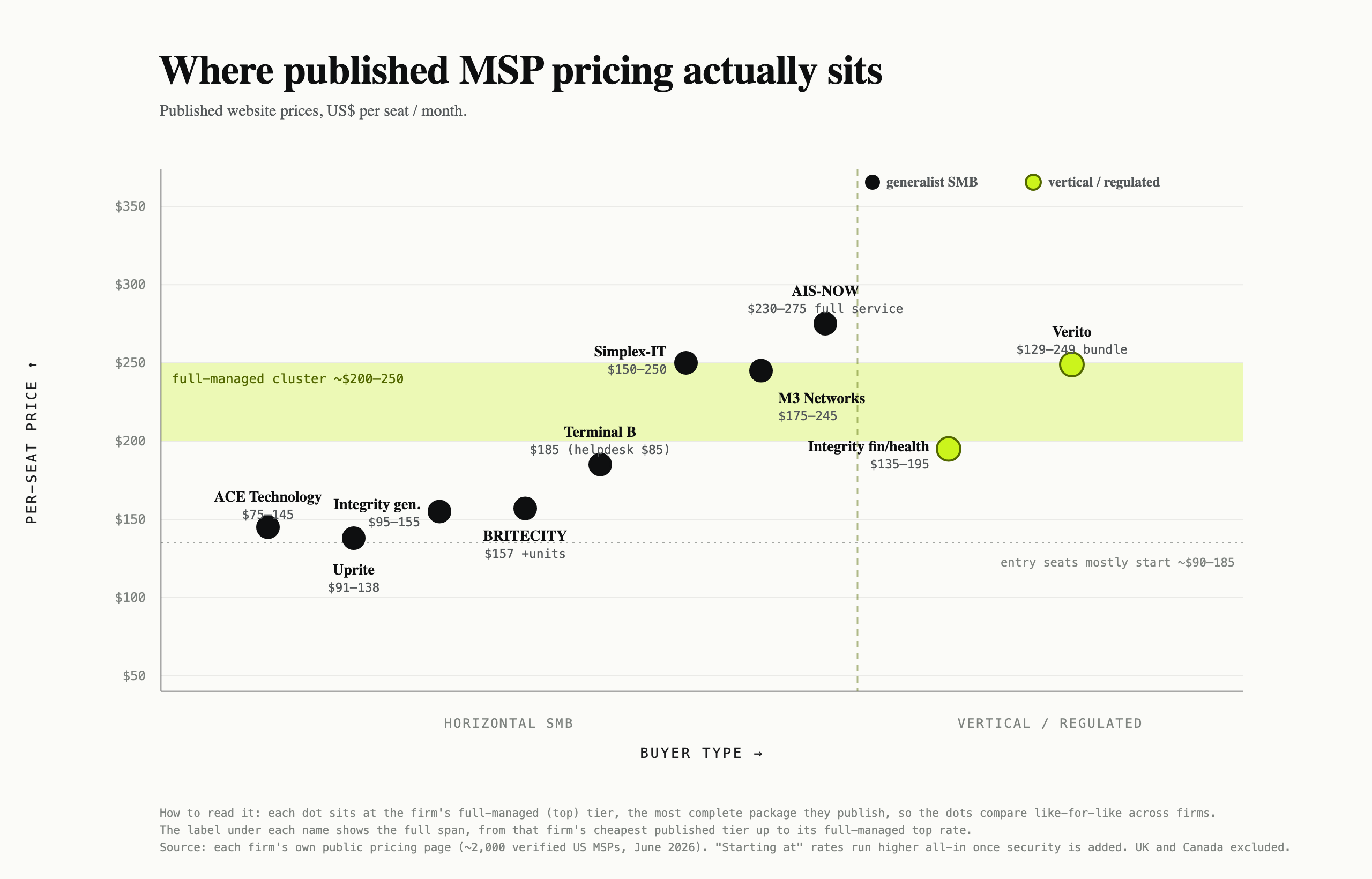
One caveat on those published numbers: a "starting at" rate on a website runs higher all-in once the full security stack is added, so treat the published figure as a floor on what that firm charges, not a ceiling. These are US firms; UK and Canada were excluded from the scrape.
The 2022 poll: where entry pricing self-reported
The second data point is a community poll of 57 US MSPs from 2022, asking what they charge for their entry or starting tier per user per month. It is dated and it is self-reported, single-question data, so read it as a directional check, not a live benchmark. But it lines up cleanly with the entry zone in the 2026 website scrape.
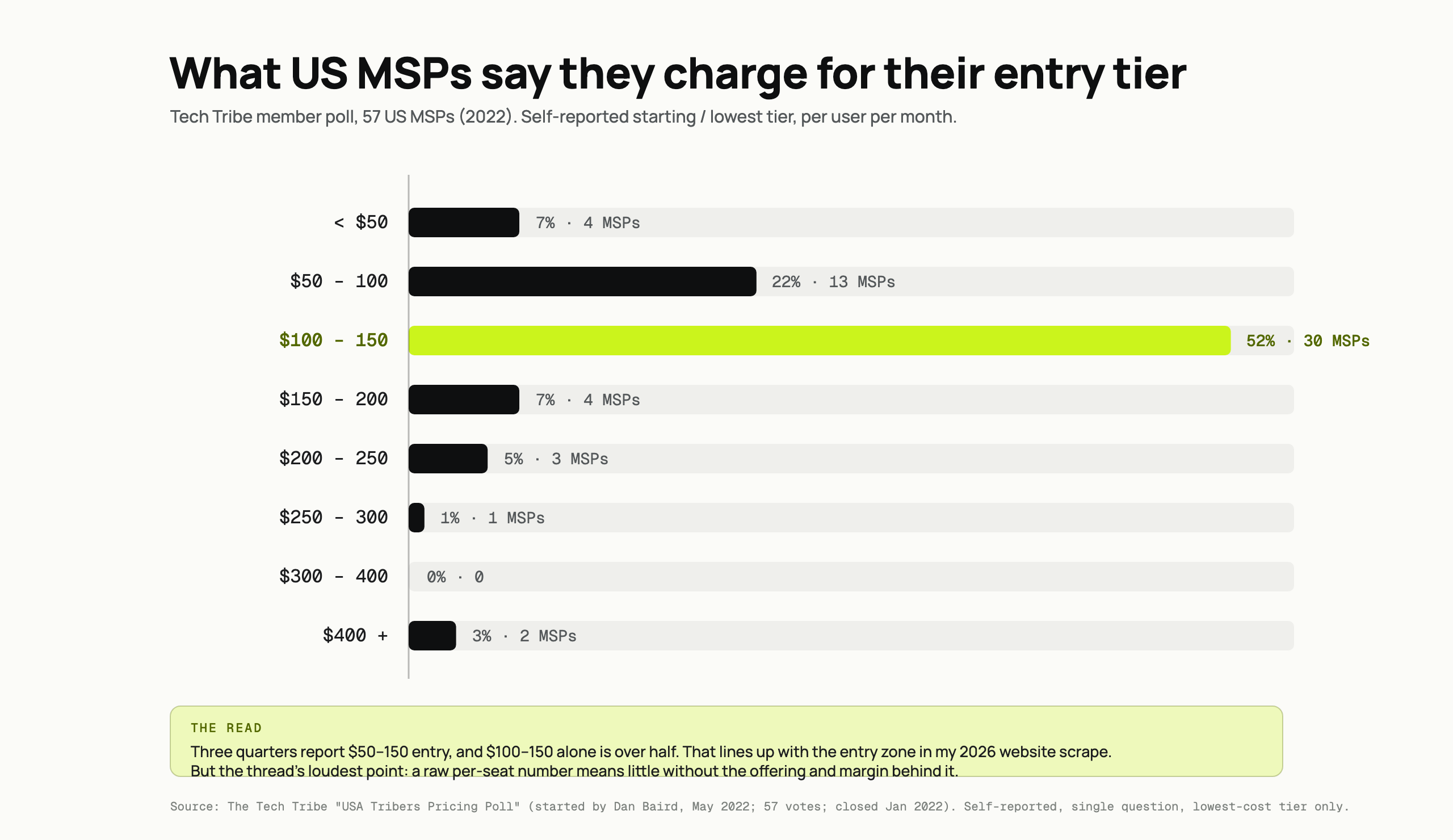
| Entry / starting tier (2022 poll, 57 US MSPs, self-reported) | Share of respondents |
|---|---|
| Under $50 / seat | 7% |
| $50 to $100 / seat | 22% |
| $100 to $150 / seat | 52% |
| $150 to $200 / seat | 7% |
| $200 to $250 / seat | 5% |
| $250 to $300 / seat | 1% |
| $400+ / seat | 3% |
Three quarters of respondents reported a $50 to $150 entry tier, and the $100 to $150 band alone accounted for over half. That maps almost exactly onto the entry zone in the 2026 scrape, which is a reasonable sign the entry-tier market has been stable. But the loudest point in that thread was not a number at all. It was that a raw per-seat figure means very little without the offering and the margin behind it. A $99 seat that includes a full security stack and a $99 seat that is monitoring-only are not the same product, and comparing their headline prices is meaningless. This is exactly why the cost-stack method matters more than the market survey: the survey tells you the range, but only your own cost stack tells you whether a given price inside that range actually makes you money.
Reconciling the floor with the market
You may have noticed the illustrative floor ($378) sits well above the published full-managed cluster ($200 to $250). That gap is the whole lesson, and it is worth being honest about rather than hiding. It usually means one of a few things, and working out which applies to you is the actual pricing exercise.
- The illustrative cost stack is heavier than a lean operator's. A shop supporting 150 seats per engineer instead of 100, on a leaner tool stack, has a much lower loaded cost and a much lower floor. The worked example is deliberately not optimized, to show the mechanics.
- Published website prices understate the all-in figure. "Starting at $200" becomes $260 once security add-ons, compliance, and projects are layered on. The published cluster is a floor on real revenue per seat, not the average invoice.
- Some MSPs are genuinely underpricing. A real share of the market sells seats that do not clear a healthy margin once fully loaded, which is precisely why "busy but broke" is a recurring complaint in the practitioner community. If your honest floor is above what your market pays, the answer is rarely to price below your floor. It is to lift utilization, trim tool bloat, or move upmarket to clients who buy the full stack.
The move is not to pick the market number or the cost-stack number and ignore the other. It is to build your real floor, look at where the market prices, and if there is a gap, fix the cost structure or the client mix rather than pricing below cost to match a competitor who may themselves be underpriced.
Why pricing discipline shows up at exit
There is a reason a finance-trained operator harps on this. How you price is an operating concern and a valuation concern at once, because they turn out to be the same thing viewed from different ends. When a buyer runs diligence on an MSP, they are not only counting recurring revenue, they are testing the quality of that revenue: is the margin real, is it defensible, and does the business have the pricing power to hold or raise rates without losing clients.
An MSP that prices from a known cost stack at a healthy, held margin reads as a business with pricing power. One that discounts reflexively below a floor it cannot even name reads as a book of underpriced contracts a buyer will have to reprice, which shows up as a lower multiple or a harder retrade at close. Recurring revenue with thin or unknown margin is worth less than the same revenue at a healthy, defensible margin, and buyers know the difference. It also feeds straight into the multiple you eventually command, laid out in the MSP valuation multiples breakdown. The mechanics of how margin and recurring-revenue quality move the number are covered in the MSP valuation drivers piece, and the way cost-plus habits quietly cap the multiple is the argument in why cost-plus pricing caps your valuation. If you want the full picture of what an MSP is worth and how the profit number is normalized, start with how to value an MSP. And for the wider pricing-model choice this article sits under, see MSP pricing models.
Frequently Asked Questions
Build the price from your own cost stack rather than copying a competitor. In published US pricing from roughly 2,000 MSPs in June 2026, full-managed seats cluster around $200 to $250 per user per month, with lighter entry tiers mostly $90 to $185. Your own floor is your fully loaded per-seat cost divided by one minus your target margin, and your list price should sit above that floor.
A healthy managed-services gross margin on recurring revenue sits in the 50% to 60% range, and the strongest operators clear 60%. An MSP running below roughly 40% is almost always underpriced, over-staffed for its seat count, or carrying a bloated tool stack it never repriced. Margin here means price minus the direct cost to deliver, as a percentage of price, not net profit.
Add up the fully loaded monthly cost to serve one seat: tooling, labor, and allocated overhead. Then divide that cost by one minus your target margin. For example, a $170 loaded cost at a 55% target margin gives a floor of $170 ÷ 0.45, which is about $378 per seat per month. Set your list price above the floor and treat the gap as discount room, never selling below the floor without a deliberate reason.
Labor is usually the largest cost line and the most misjudged. Take one engineer's fully burdened annual cost and divide by the seats that engineer can realistically support. The same engineer across 150 seats produces a far lower per-seat labor cost than across 75. Utilization quietly makes or breaks margin, because the seat price can be identical while the labor cost behind it swings by half.
Per-user pricing is the dominant model because it is simple to quote, scales with the client, and maps to how you staff. It works well when users have multiple devices, since one price covers the person. Per-device can fit environments with shared or server-heavy setups. Either model only protects you if the price sits above your loaded per-seat or per-device cost at your target margin.