There is no single right answer, and any consultant who gives you one has not run the test. Putting pricing on your website trades lead volume for lead quality. If you publish a number, fewer people fill in your form, but the ones who do are pre-qualified on budget and further down the buying decision. If you hide it, you catch more leads at the top of the funnel and spend more of your sales time discovering that half of them were never going to pay your rate. The correct choice depends on which of those two problems is actually hurting you right now: too few conversations, or too many bad ones. This piece steelmans both sides honestly, then tells you what we decided at the US MSP where I run growth, and why.
I come at this from two angles. I spent a decade in investment banking and private equity working on transactions worth more than seven billion dollars, so I think about pricing the way a buyer of your business eventually will, as a signal of margin quality and pricing power. And today I run growth inside a US MSP, which means I own the actual tradeoff this article is about: I watch what happens to our pipeline when a price is visible versus when it is not. This is not a theory piece. It is the debate as it plays out on real MSP peer communities, where a single thread on putting your price on your website ran to more than ninety replies without reaching consensus, set against what the numbers and the sales math actually support.
If you want the pricing models themselves first, read MSP pricing models compared and how much an MSP should charge per seat. If you care about pricing because you are thinking about a sale one day, start with what MSPs actually sell for. This article assumes you already have a price and are deciding whether to show it.
Why this is genuinely contested, not settled
Most "put your price on the site" advice online is written by SEO and conversion consultants who sell to everyone, so their answer is always yes, because transparency is good copy and it is not their pipeline on the line. Inside the MSP community itself the picture is completely different. When owners debate this among themselves, the thread does not resolve. It runs long, it splits roughly down the middle, and the smartest contributions on both sides are making the same underlying point from opposite directions: a per-seat number, on its own, is close to meaningless.
That is the key to the whole argument. An MSP price is not a price for a product. It is a price for a bundle whose contents vary wildly between firms, from what security is included, to whether onsite support is unlimited, to how the co-managed and project work is billed. So the real question is not "should I show my price." It is "can I show a number in a way that helps a good-fit buyer and does not mislead them or hand my competitor a stick to beat me with." Owners disagree because they have genuinely different books of business, sales motions, and competitive positions, and the right answer is different for each. Below are the strongest versions of both cases, not the strawmen each side usually argues against.
The case for publishing pricing
The strongest argument for putting a number on the site is that it does your first sales filter for you, for free, while you sleep. Every prospect who lands on your pricing page and leaves because the number is too high was a meeting you did not have to take, a proposal you did not have to build, and a discovery call you did not have to run to find out they wanted to pay half your rate. For an owner whose real constraint is time, not leads, that filter is worth more than the extra top-of-funnel volume a hidden price would have caught.
The second argument has grown sharply more important in the last two years, and it is the one most MSP owners are underweighting. Buyers now research vendors through AI search and answer engines before they ever fill in a form. A page with a clear, structured price, especially in a table, is far more likely to be read, understood, and cited by an AI engine answering "what does managed IT cost" than a page that says "contact us for a custom quote." Hidden pricing was a minor conversion choice in the old search world. In an AI-discovery world it is a visibility choice, and the firms with a defensible published number are the ones getting surfaced in the answer.
The third argument is trust and self-qualification. A well-run buyer, the kind you actually want, often reads a refusal to publish any pricing as a signal that the number is negotiable, inconsistent between clients, or embarrassingly high. Showing a credible range, framed as a starting point, says the opposite: we know what we are worth, we charge it consistently, and we are confident enough to say so. That reads as strength to a sophisticated prospect, and it pre-sells your positioning before the first call.
The case against publishing pricing
The strongest argument against is the one that keeps that ninety-reply thread from ever resolving: a number without its context does not inform the buyer, it anchors them, and it anchors them low. The prospect sees your starting figure, mentally files you at that price, and every conversation afterward is you climbing uphill to justify why the real, security-loaded, all-in number is higher. You have handed away your anchor before you ever got to frame the value. In a bundle business where the cheapest published tier and the full-managed tier can be more than double each other, that is a real cost.
The second argument is competitive. Your published price is visible to every competitor in your market, and MSP markets are local and small. A larger competitor can read your number, match it, and add "unlimited onsite support" on top to take the deal, a move that happens often enough in the community that owners trade war stories about it. Publishing your price can arm the exact firm best positioned to undercut you.
The third argument is lead volume, and it is real even if it is the least sophisticated. Some genuinely good-fit buyers will not self-select out at a number on a page, because they cannot yet see the value that justifies it, but they would have been persuadable in a conversation. Hide the price and you get that conversation. Publish it and you lose some of those people before you ever get to make your case. If your constraint is too few conversations rather than too many bad ones, this cost lands directly on the metric that matters to you.
Why a raw number misleads without the offering behind it
Both camps ultimately converge on this, so it deserves its own treatment. The loudest, most-agreed point in the community debate is not "show it" or "hide it." It is that a per-seat figure means almost nothing without the package and the margin behind it. Two MSPs can both publish "$150 per user" and be selling entirely different businesses. This is exactly why a naked number on a page is dangerous: it invites a comparison the buyer is not equipped to make.
| What "$150 per user" can hide | Firm A | Firm B |
|---|---|---|
| Security stack | Full stack included (EDR, MDR, email security) | Antivirus only; security sold as an add-on |
| Support model | Unlimited remote and onsite | Remote only; onsite billed hourly |
| Projects and co-managed work | Included up to a cap | Billed separately at project rates |
| Microsoft licensing | Bundled and managed | Passed through, client buys direct |
| Effective all-in cost | Close to the published number | Often far above it once security is added |
The practical takeaway is that if you do publish, you cannot publish the number alone. You have to publish enough of the bundle alongside it that a good-fit buyer understands what they are comparing. A price with no offering behind it is the worst of both worlds: it anchors low and it informs no one.
What the pricing numbers actually say
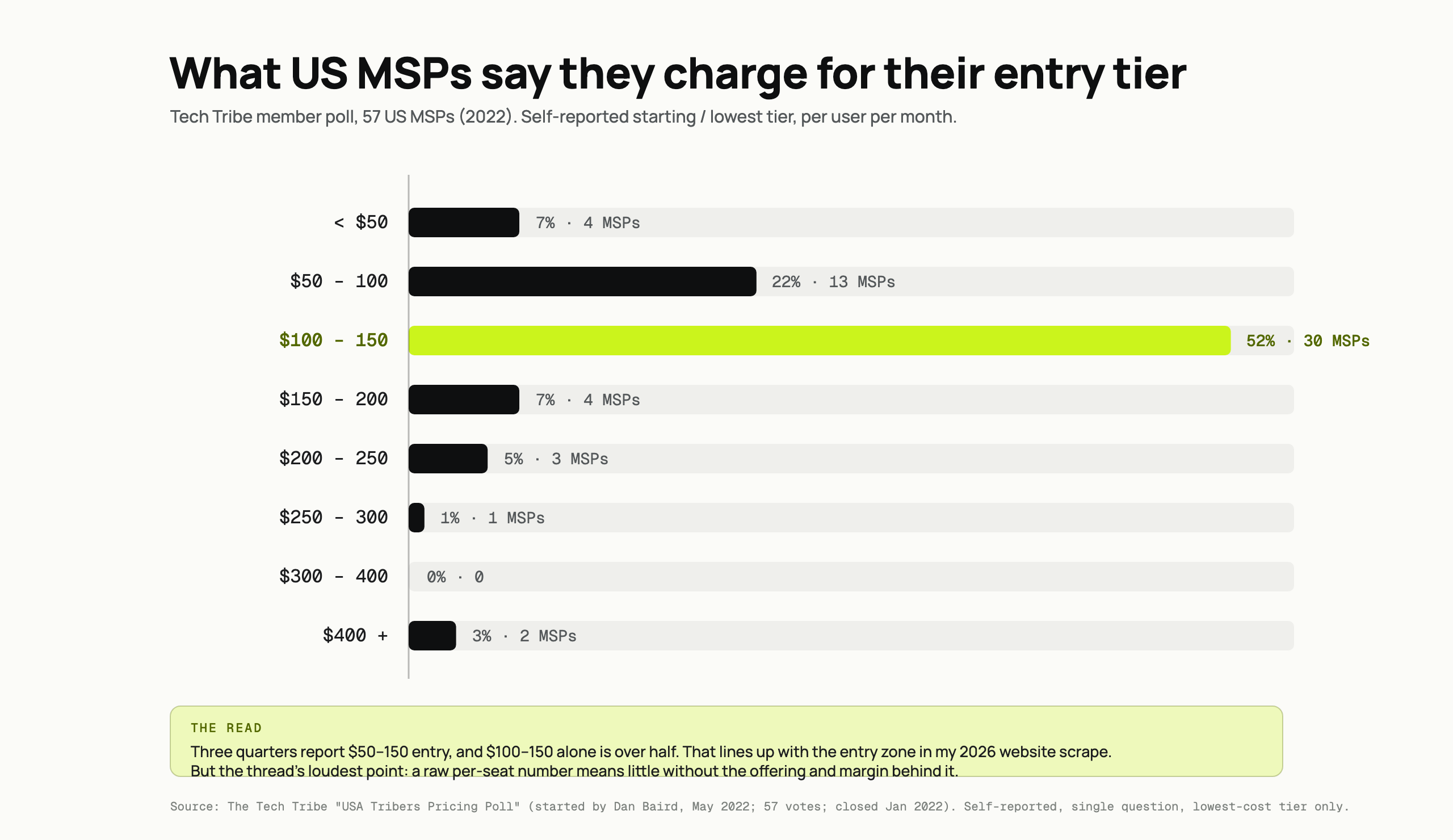
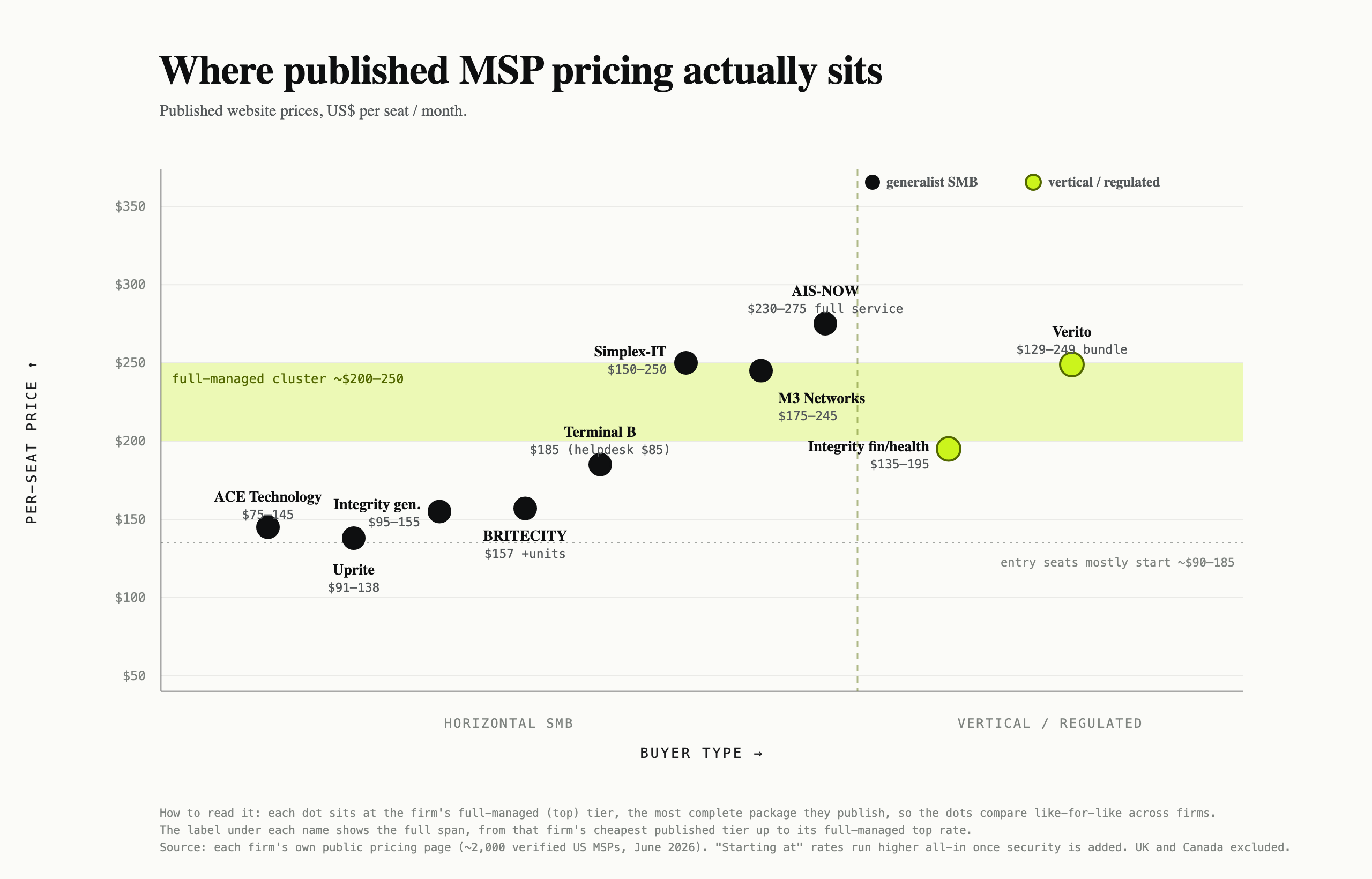
Before deciding whether to show a number, it helps to know where real US MSP pricing sits, because part of the reluctance to publish is owners quietly worrying their number is out of step with the market. Two datasets are worth putting side by side. The first is a community poll of US MSPs from 2022 that asked owners what they charge for their entry or starting tier. The second is my own June 2026 scrape of the public pricing pages of a large set of verified US MSPs. They measure slightly different things, the poll captures the lowest tier owners will admit to, the scrape captures what firms are willing to publish, but together they bracket reality.
| Reference | What it measures | Where pricing lands (US$ per seat / month) |
|---|---|---|
| 2022 community pricing poll (57 US MSPs, self-reported) | Entry / lowest published tier | $100 to $150 was the single most common answer at 52 percent of respondents; roughly three quarters reported $50 to $150 |
| June 2026 published-pricing scrape (~2,000 verified US MSPs) | Full-managed top tier, published on the firm's own site | Full-managed packages cluster around $200 to $250; entry seats mostly start around $90 to $185 |
Two things fall out of this. First, published entry prices and full-managed prices are far apart, often more than double, which is precisely why a single naked number misleads. Second, the 2022 poll's own loudest lesson, repeated by the owners taking it, was that the raw per-seat figure told you very little without knowing what each firm bundled into it. That is the same conclusion the website-pricing debate keeps reaching from the other direction. Treat the poll as a dated 2022 signal, not a current benchmark, but the structural point it makes has not aged: ranges, not points, and never a number stripped of its offering.
The operator verdict: what we chose and why
At the MSP where I run growth, we publish a starting price and a clear picture of the bundle, and we do not publish a full custom quote. That is a deliberate middle position, and the reasoning maps directly onto the two-problem framing at the top of this article.
Our binding constraint is not lead volume. It is sales-team time and lead quality. Every hour a strong technician-turned-owner or account manager spends on a discovery call with a prospect who was never going to clear our rate is an hour stolen from delivery and from good-fit pipeline. A visible starting number does that filtering for us before anyone books. We accept that we catch fewer raw leads in exchange for the ones who arrive already knowing roughly what we cost and choosing to talk anyway. For a firm positioned on quality rather than price, that trade is correct, and the AI-discovery benefit is a bonus we are not willing to give up now that buyers research this way.
That filter only pays off if someone works the requests that do get through, and in my experience most of the loss happens after the form fill, in the reply, the second call and the proposal chase, which I walk through in what happens to an MSP lead after the form fill.
The reason we stop short of a full quote is everything the case-against section laid out. A complete price, divorced from the discovery of what a specific client actually needs, anchors low and arms competitors, with no upside we cannot already get from a well-framed range. So we show enough to qualify and to be discoverable, and we hold back the parts that only a conversation can price correctly. If your own constraint is the opposite of ours, if you are starving for conversations and can comfortably handle bad-fit calls, the honest answer is that hiding your price may be right for you. The framework decides it, not a rule.
How to publish a price without losing the deal
If the framework points you toward showing a number, the execution is where most MSPs get it wrong, publishing either too little to be useful or a bald figure that does all the damage the case-against warned about. A few disciplines make the difference.
- Publish a range or a "starting at," never a single point. A range signals that the real number is set by needs, which is true, and it stops the buyer anchoring on your floor as your ceiling.
- Show the bundle next to the number. Whatever price you publish, put enough of what is included beside it, security, support model, projects, licensing, that a good-fit buyer can tell what they are comparing. This is the single fix that turns a misleading number into an informative one.
- Frame it as the entry to a value conversation, not the whole answer. Make clear the published figure is a starting point and the right package depends on their environment. That preserves your ability to price up from discovery.
- Match the transparency to your position. If you are a quality-led firm confident in your rate, publishing reinforces that. If you compete partly on price in a market with a bigger, cheaper rival who will copy you, weigh the competitive cost seriously before you publish a precise number.
There is also a valuation footnote worth keeping in view, because it is the lens I cannot switch off. Pricing confidence, the willingness to charge and to state a real rate, shows up years later as margin quality and pricing power, which is exactly what a buyer of your MSP pays a higher multiple for. Recurring revenue mix and margin quality are among the strongest levers on your eventual sale price; see the drivers that move an MSP's multiple and, if a sale is on the horizon, exit readiness. An MSP that is too nervous to state its price on its own website is often the same MSP quietly discounting its way into a lower multiple. How you handle pricing publicly and how a buyer eventually reads your margins are the same discipline seen at two different moments.
Frequently asked questions
Usually yes, in raw count, and that is the point. A visible price filters out prospects who were never going to pay your rate before they fill in a form, so you get fewer leads but a higher share of qualified ones. Whether that is good for you depends on your constraint. If you have too few conversations, hiding the price catches more of them. If you have too many bad-fit calls eating your sales time, a published number does the first qualification for you.
Publish a starting price or a range rather than a single number, and show the bundle beside it, what security, support model, projects, and licensing are included. A range signals the real figure depends on the client's needs and stops buyers anchoring on your floor. Holding back the full custom quote preserves your ability to price up from discovery while still qualifying and staying discoverable to AI search.
They can see it, and in small local MSP markets a larger competitor can match your number and add unlimited onsite support to take the deal. This is a genuine cost of publishing, and owners trade real stories about losing price-matched deals this way. If you compete partly on price against a bigger, cheaper rival, weigh this seriously. If you are positioned on quality and confident in your rate, the competitive risk is smaller than the qualification and discoverability gains.
A 2022 community poll of 57 US MSPs found the most common entry-tier answer was $100 to $150 per user per month, with roughly three quarters reporting $50 to $150. A June 2026 scrape of about 2,000 verified US MSP pricing pages found full-managed top tiers clustering around $200 to $250, with entry seats mostly starting around $90 to $185. Treat the poll as a dated signal, and remember a raw per-seat number means little without the package behind it.
It can be. Buyers increasingly research MSPs through AI answer engines before contacting anyone, and a page with a clear, structured price, especially in a table, is more likely to be read and cited than one that only says "contact us for a quote." In an AI-discovery world, publishing a defensible range is partly a visibility decision, not only a conversion one, which is a meaningful shift from a few years ago.
Pricing discipline and your eventual exit
How you price today shows up years later as the margin quality and pricing power a buyer pays a premium for.