Most MSPs in 2026 price per user per month, and for good reason: it is the model that tracks the way clients actually consume support and the model that buyers of MSPs reward when they look at your books. Per-device pricing still exists and still fits a narrow set of shops, flat-fee all-you-can-eat trades margin certainty for a simpler sale, and value-based pricing is the one everyone talks about and few genuinely run. This page lays out every model with its honest tradeoff, shows where published per-seat pricing actually sits from our own scrape of around 2,000 US MSPs, and then puts on the finance hat most pricing guides skip: which model makes your recurring revenue worth more when someone eventually buys you.
I spent a decade in investment banking and private equity working on transactions worth more than $7bn in aggregate, including a board seat through a $300m-plus PE exit. Today I run growth inside a US managed services business, so I read pricing from two seats at once: the finance seat that priced recurring-revenue companies for a living, and the operator seat that has to sell a package and defend a margin. I am not here to sell you a pricing calculator or a "book a call" funnel. The models below are described with their real weaknesses, the numbers come from our own dataset with the method stated, and where the community is loud but wrong I say so.
The five models at a glance
There is no single correct MSP pricing model. There is a short menu, and each option optimizes for a different thing: some for billing simplicity, some for margin protection, some for how the client wants to buy. The mistake is treating the model as the whole pricing decision. The model is the unit you meter. Packaging (what is inside each tier) and the actual dollar figure sit on top of it, and both matter more to your margin than the model name does. Here is the menu, and what each one really trades away.
| Model | What you charge for | Where it fits | The tradeoff it makes |
|---|---|---|---|
| Per user (per seat) | Each person you support, all their devices included | The default for modern managed services; most SMB and knowledge-work clients | Simple and client-friendly, but a heavy multi-device user costs you more than a light one at the same price |
| Per device (per endpoint) | Each managed workstation, server, firewall, or piece of hardware | Device-heavy environments, warehouses, kiosks, shops where headcount is low but hardware is high | Easy to count and defend, but it penalizes the client for good hygiene and quietly rewards device sprawl |
| Tiered / bundled (good-better-best) | A named package (per user or per device) with a defined scope of services | Almost everyone; it is a packaging layer that sits on top of per-user or per-device metering | Anchors the client to a value menu instead of a line-item argument, but a badly drawn tier boundary trains clients to buy down |
| Flat fee / all-you-can-eat | One fixed monthly number for the whole environment, unlimited support | Mature, standardized environments the MSP controls tightly | Cleanest possible sale and predictable client bill, but you absorb all the volume risk; one bad-hygiene client can eat the margin |
| Value-based | The business outcome (uptime, risk reduction, continuity), not the inputs | Rare in practice; works best with vertical or high-stakes clients who feel the cost of downtime | Highest margin ceiling and hardest to commoditize, but genuinely difficult to quantify and to sell without a specific, believable outcome |
Notice that most real MSPs run a combination: a per-user or per-device meter, wrapped in tiered packaging, occasionally with a flat-fee option for the right client. Pure value-based pricing is the aspiration in the pricing forums and the exception in the invoices. Take each in turn.
Per user (per seat): the model that won
Per-user pricing charges a fixed amount for each person you support, with all of that person's devices, their laptop, their desktop, their phone, their access to your helpdesk, rolled into the seat. It has become the default modern managed-services model, and the logic is sound. Clients think in headcount, not hardware. A finance director knows how many people work at the company; she does not know or care how many endpoints IT is watching. Pricing per user speaks the client's language, scales cleanly as they hire, and makes your revenue legible: a 40-seat client at a given rate is a number the client can sanity-check in their sleep.
It also produces the cleanest recurring-revenue story, which matters later when you sell, and I will come back to that. The weakness is real but manageable: a per-seat price is an average, and averages lose money on the extremes. A power user running three machines and a lab costs you more to support than a receptionist with one laptop, yet both sit at the same seat price. If your client base skews heavy on multi-device users, a flat per-seat rate quietly erodes your margin. The fix most mature shops use is to define a seat carefully (some number of devices included, extra devices billed) rather than abandon the model.
Where per-seat pricing actually sits
Here is data most pricing guides do not have. We scraped the published pricing pages of around 2,000 US MSPs in June 2026 and plotted the ones that publish real per-seat numbers, comparing each firm at its full-managed (top) tier so the dots compare like for like. The picture below is what the market actually advertises, not what a vendor wishes it charged.
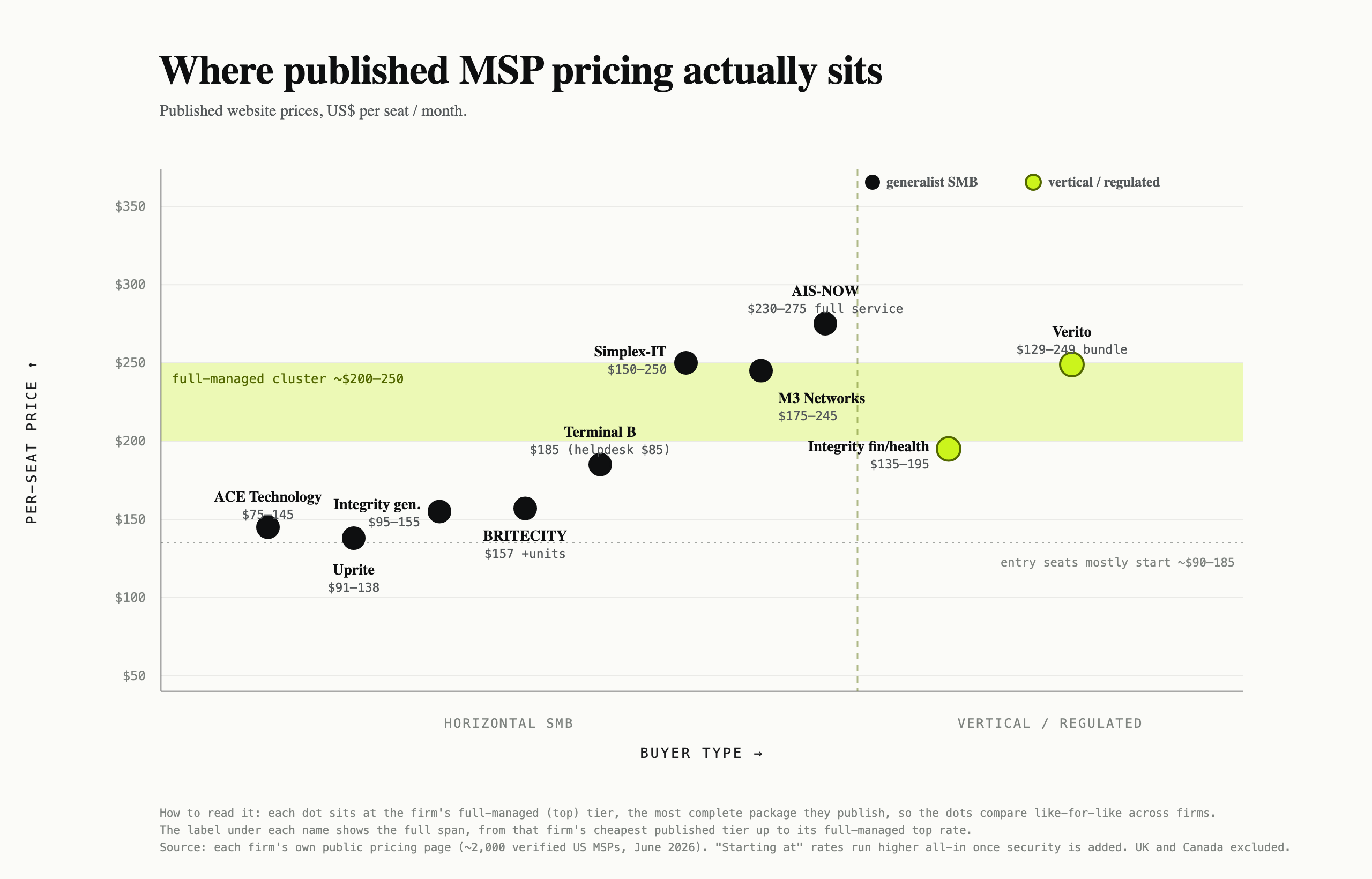
Two readings matter. The full-managed tier, the most complete package these firms publish, clusters around $200 to $250 per user per month. Entry seats, the cheapest tier each firm advertises, mostly start in the $90 to $185 range. Vertical and regulated-industry MSPs (accounting, finance, healthcare) sit at the top of the range, which is the value-based effect showing up in real numbers: when the client operates under compliance pressure and downtime is expensive, the seat price rises. One honest caveat on these figures: a published "starting at" rate almost always runs higher all-in once security and compliance are actually added, so read the advertised entry number as a floor, not the real deal.
If you want the unit-economics walk from a client's cost stack up to a defensible seat price, rather than just the market range, that is its own piece: how much an MSP should charge builds the seat price from the bottom up.
Per device (per endpoint): the legacy model that still fits some shops
Per-device pricing charges for each managed asset: a rate per workstation, a higher rate per server, a rate per firewall or managed switch. It is the older model, and for most modern SMB clients it has lost to per-user for a simple reason: people now carry several devices, so device counts became a poor proxy for support load and an awkward thing to quote. But it has not disappeared, and it should not, because there are environments where devices are the right unit.
Think of a warehouse, a manufacturing floor, a retail chain, a medical practice with shared workstations: low headcount, high device count, lots of hardware that needs patching and monitoring but few humans logging support tickets. In those shops, per-user pricing undercharges you badly, because the work is in the machines, not the people. Per-device is also easy to count and easy to defend in a renewal conversation; the client can see the asset list. The structural weakness is the one worth naming out loud: per-device pricing penalizes the client for good hygiene. Every time they consolidate, retire an old machine, or move a workload to the cloud, your revenue drops, even though your value did not. And it quietly rewards device sprawl, which is not a great thing to have your commercial incentives pointed at. Use it where the environment is genuinely device-defined; do not default to it out of habit.
Tiered and bundled pricing: the packaging layer everyone actually uses
Tiered pricing, the good-better-best or gold-silver-bronze menu, is not really a separate metering model. It is a packaging layer that sits on top of per-user or per-device, and it is how most competent MSPs sell. Instead of one price, you offer three defined packages: a base tier with core management, a middle tier that adds security and backup, a top tier that adds compliance, vCIO, and whatever your best clients need. The client still pays per seat or per device inside each tier; the tiers just define scope.
Done well, tiering moves the client's decision from "is this line item worth it" to "which package fits us," which is a far better conversation to be having, because it anchors on value delivered rather than on your effort. The pricing community spends real energy on this, right down to what to name the tiers, and the good instinct underneath the naming debate is correct: a clear value menu sells better than an itemized invoice. The trap is a badly drawn tier boundary. If your middle tier is where the real security lives but your base tier is priced close to it and looks "good enough," you have trained your clients to buy down, and worse, you have left them under-protected, which becomes your problem when something breaks. Draw the boundaries so the tier you want most clients on is the obvious value, and so the base tier is genuinely safe to sell rather than a liability you are hoping nobody chooses.
Flat fee and all-you-can-eat: the clean sale that transfers risk to you
Flat-fee, or all-you-can-eat (AYCE), pricing puts one fixed number on the whole environment: unlimited support, unlimited tickets, a predictable monthly bill for the client. It is the cleanest possible sale. The client loves a single line item with no surprises, and it removes every "why was I billed for that" conversation. For a mature, standardized environment that you control tightly, where you have driven out the chaos and the ticket volume is stable, it can be an excellent and highly profitable model.
The tradeoff is that you absorb all of the volume risk. Under flat fee, your margin is entirely a function of how well-run the client's environment is, and you no longer get paid more when things go wrong. That inverts your incentives in a healthy way (you now profit from stability, so you invest in it) but it also means one chaotic, bad-hygiene client can eat the margin on the account entirely. Flat fee rewards MSPs that are disciplined about onboarding, standardization, and saying no to environments they cannot control. It punishes MSPs that sell unlimited support into a mess and hope. The honest rule: offer flat fee where you own the standard, not where you are inheriting someone else's technical debt at a fixed price.
Value-based pricing: what it actually means, and why few genuinely run it
Value-based pricing is the one every pricing think-piece points at as the promised land, and the framing is right even though the execution is rare. The idea is that you price the outcome you deliver, business continuity, risk reduction, uptime, peace of mind, rather than the inputs you consume (hours, devices, seats). The argument, made well in the MSP peer communities, is that the client is not buying your standardized stack; they are buying the absence of a bad day. If you price the value of that outcome, you escape the commodity race to the bottom that per-device and cheap per-seat pricing can drag you into.
It is correct, and it is genuinely hard. The reason few MSPs truly run value-based pricing is that quantifying the value is difficult and selling it is harder. "What is an hour of downtime worth to you" is a real question, but it only lands with a client who feels that cost concretely, which is why value-based pricing works best in verticals where downtime or a breach is obviously, expensively catastrophic: a law firm that cannot bill, a medical practice that cannot see patients, an accounting firm mid-tax-season. That is exactly why our own pricing scrape shows regulated and vertical MSPs sitting at the top of the per-seat range. In practice, most MSPs do not run pure value-based pricing; they run per-seat or tiered pricing with a value-based justification, which is a reasonable and honest hybrid. The mistake is thinking value-based is a metering unit. It is a selling posture. It lives on top of whatever unit you meter.
There is a deeper strategic point here that deserves its own treatment, because the opposite of value-based pricing is not per-device, it is cost-plus, and cost-plus pricing does something quietly damaging to what your business is worth. I make that case in full in cost-plus pricing is quietly capping your MSP's valuation.
The finance lens: which model buyers of MSPs prefer, and why
This is the part almost every MSP pricing guide leaves out, and it is the part I am actually qualified to speak to. When someone eventually buys your MSP, whether a private-equity platform, a consolidator tucking you in, or a strategic acquirer, they are not buying your revenue at face value. They are buying the quality of that revenue, and your pricing model is one of the biggest inputs into how they score it. Two MSPs with identical top-line revenue can be worth materially different multiples based on how that revenue is priced and contracted.
Here is what a buyer's diligence rewards. Recurring, contracted, per-seat revenue reads as the highest-quality revenue there is, because it is predictable, it scales with the client's headcount, and it is not tied to a decaying asset count or to project work that has to be re-won every quarter. Per-device revenue is still recurring, but a buyer knows it decays as clients modernize, so it scores slightly softer. Break-fix and hourly work, priced on inputs, is the lowest-quality revenue in the stack, because it does not recur reliably and it disappears the moment the client's environment stabilizes. When a buyer models your future cash flows, the per-seat contracted base gets the highest confidence and the project and break-fix lines get discounted hard. The result shows up in the multiple.
The size of that effect is not small. In the verified comp set behind our valuation work, buyer type and revenue quality move the multiple by turns, not decimals: a private-equity platform deal ran a 13.6x median EV/EBITDA against 7.8x for a strategic trade sale, and the businesses at the top of that range were the ones with clean, high-recurring, high-margin books. If you want the full size ladder and what MSPs actually sell for, that is the pillar on MSP valuation multiples, and the mechanics of normalizing your own numbers before a buyer does live in how to value an MSP. Pricing model is upstream of all of that. Recurring revenue mix is one of the core levers that moves your multiple, alongside security weighting, vertical depth, and size, and I break those down in the levers that move an MSP's multiple. The short version: the pricing model that produces the cleanest recurring revenue (per-seat, contracted, tiered so clients are on real packages rather than month-to-month improvisation) is also the pricing model that makes you worth the most when you sell. That alignment is rare and worth leaning into. The way you price for margin today is the same way you price for a multiple later.
| Revenue type | How a buyer scores it | Why |
|---|---|---|
| Per-seat, contracted, recurring | Highest quality | Predictable, scales with client headcount, does not decay with asset counts; strongest input to future cash flows |
| Per-device, recurring | Good, scored slightly softer | Recurring, but the buyer knows it erodes as clients consolidate and modernize |
| Tiered / bundled recurring | High quality when packaged well | Signals disciplined commercial operation and lower churn risk; clients on defined packages read as stickier |
| Project and break-fix, hourly | Lowest quality | Does not recur reliably, disappears as environments stabilize; heavily discounted in a diligence model |
So which model should you pick
For most MSPs in 2026, the answer is per-user pricing, wrapped in a clear tiered package, with a flat-fee option reserved for the mature environments you genuinely control, and a value-based selling posture layered over the top wherever the client feels the cost of downtime. Reach for per-device only where the environment is truly device-defined rather than people-defined. That combination is not a compromise; it is what the market has converged on because it prices for margin today and for a clean recurring-revenue story tomorrow, and those turn out to be the same thing.
Two adjacent decisions sit right next to the model choice and are worth settling deliberately. The first is the actual number: the model tells you what to meter, but not what to charge, and getting from your cost stack to a seat price that holds up is its own exercise, which I walk through in how much an MSP should charge. The second is whether to publish that number at all: putting pricing on your website is a genuinely contested call in the MSP world, one I had to make at the shop where I run growth, and I lay out both sides and the verdict in should an MSP put pricing on its website. Get the model right first. Then the number. Then the shop-window decision.
Per-user (per-seat) pricing is the default modern model, usually wrapped in a tiered good-better-best package. It charges a fixed amount per person supported, with all their devices included, which matches how clients think about their business (headcount) and produces the cleanest recurring revenue. Per-device pricing still fits device-heavy, low-headcount environments, and flat-fee pricing suits mature environments the MSP controls tightly, but per-user is where the market has converged.
Based on our June 2026 scrape of around 2,000 US MSP pricing pages, full-managed top tiers cluster around $200 to $250 per user per month, and entry tiers mostly start in the $90 to $185 range. Vertical and regulated-industry MSPs sit at the top of that range. Note that a published "starting at" rate usually runs higher all-in once security and compliance are added, so treat the advertised entry number as a floor rather than the real all-in price.
It has the highest margin ceiling and it is the hardest to commoditize, but few MSPs genuinely run it, because quantifying and selling an outcome is difficult. Value-based pricing works best in verticals where downtime or a breach is obviously expensive, like law, healthcare, and accounting. In practice most MSPs run per-seat or tiered pricing with a value-based justification, which is a reasonable hybrid. Value-based is a selling posture that sits on top of a metering unit, not a metering unit itself.
Buyers reward recurring, contracted, per-seat revenue most, because it is predictable, scales with client headcount, and does not decay with asset counts. Per-device revenue is still recurring but scores slightly softer because it erodes as clients modernize. Project and break-fix revenue is the lowest quality because it does not recur reliably. Since revenue quality is a core driver of your valuation multiple, the pricing model that produces the cleanest recurring revenue is also the one that makes you worth the most at exit.
Only where you tightly control the client's environment. Flat-fee pricing gives the client a single predictable bill and gives you the cleanest possible sale, but it transfers all of the volume risk to you: your margin becomes entirely a function of how well-run the environment is. It works beautifully for mature, standardized clients and can lose money fast on a chaotic, bad-hygiene client. Offer it where you own the standard, not where you are inheriting someone else's technical debt at a fixed price.