On November 17, 2026, I checked the AI Overview Google showed for "msp seo". An AI Overview is the AI-written answer at the top of Google's results, and "msp seo" is what an MSP owner types when shopping for this very service. The answer cited twelve sources, the pages it linked to as its basis. None was an MSP's own website. And none of the twelve sites also appeared in the organic results, the ranked links listed under the answer.
The people who buy managed information technology (IT) from you ask different questions. "Which IT support company should I choose" is one of the prompts Cortavo, an MSP, tracked across ChatGPT and other assistants every month. Your ranking report cannot tell you whether your firm was named in that answer.
Google's own guidance says the usual SEO best practices still apply to its AI answers and nothing extra is required. Three things do change. The shortlist, as I see it, forms inside the answer, before anyone clicks. The cited sources need not be the pages that rank. And citations and AI-referred leads have to be counted on their own: citations by asking the assistants the same buyer questions every month, leads with their own source value in your customer relationship management (CRM) system.
I spent ten years in investment banking and private equity, then built what became the largest cannabidiol (CBD) marketplace in the UK, aiming for a leading European cannabis business, and raised $4M+ to do it. Google and Facebook ban CBD advertising, so search had to carry the whole business. Brands in the category asked us to run the same search work for them, and that became NUOPTIMA, the agency I founded in 2020. When the CBD market collapsed, I shut the marketplace and put everything into the agency. Today it is a team of 25+ specialists, and it works only with MSPs.
What Google's AI answer for "msp seo" cited on November 17, 2026
Of the twelve cited sources, five were YouTube videos, three of them from a single channel. One was a LinkedIn article. Five were the websites of marketing or SEO agencies, and one was a software vendor's blog post.
This is one search, checked once, in one market (US, English, desktop). "msp seo" is what an owner types when buying SEO, not what a client types when buying managed IT. It shows how one Google AI answer in this category drew its sources, not what Cortavo's buyers saw, which I did not check.
Google's own documentation says AI Overviews and AI Mode (the version of Google search where the whole result is an AI answer) may run several related searches behind one question, and that the two may use different models, so the responses and links they show will vary.
I take one thing from it. A page-one ranking and a citation in the answer are two separate checks.
How NUOPTIMA runs organic, local and AI search as one program
We work three surfaces together: the ranked links (organic search), your Google Business Profile and map results (local search), and the answer ChatGPT, Gemini or Google's AI features write before anyone clicks (AI search). We judge them on contracted revenue in the CRM first, then qualified leads, then early signals such as AI mentions.
For AI search, the job is making the MSP easy to cite: the same facts everywhere, pages that answer the buyer's question in their first two sentences, mentions on sites the assistants already trust, and a place on the best-of pages buyers read. No one can promise a citation, and I would distrust anyone who does.
The longer record is organic. NUOPTIMA's published case study for Microminder Cyber Security, an MSP selling managed security, shows 3 to 4,503 ranking keywords in 23 months on a brand-new domain, and about 20 quality leads a month. Eden Data, a security and compliance provider in Austin, went from 164 to 2,618 ranking keywords between May and November 2023, by NUOPTIMA's published case study. Neither case reports on AI answers.
NUOPTIMA's award record, newest first: US Search Awards 2026, Silver, Best Use of Search, B2B (SEO), for the Cortavo case study; The Drum Awards for Search 2023, Finalist; UK Search Awards 2023, Shortlisted, Best Use of Search, B2B (SEO), for Microminder Cyber Security; and UK Search Awards 2022, Winner, Best Use of Search, B2B (SEO). The most recent entries were MSP and cybersecurity case studies.
At Cortavo, AI citations were a target before any page was written
Cortavo's engagement began in May 2025, with NUOPTIMA doing the work. I'm also Cortavo's CRO, so I saw both the SEO work and the sales pipeline it fed.
AI citations went on the scorecard from day one, next to sales, leads and rankings. NUOPTIMA's case study gives the reason: "an unbranded challenger MSP has to be recommended, not just found." The same case study says that "in many buying prompts, AI tools do not return ten blue links; they return a short list of recommendations." No method is given, so treat it as the agency's observation; I share it, as an opinion.
The content built most directly around prompts came in months 10 to 12: comparison and list pages phrased the way buyers phrase prompts ("best X", "top Y"), with live citation monitoring. Before that came technical fixes, city and industry guides, reviews and placements on other sites. The case study says the guides were written with direct answers so AI tools could cite them, and it calls months 7 to 9 "Authority and AI". In my view most of that is work any serious Google plan would include anyway.
The published result: Cortavo started "not cited", against a target of twice the closest competitor's citations. It reached 4x the closest competitor, with 224 tracked mentions across ChatGPT, Gemini, Claude and Perplexity. The prompt set, the competitor set and the period behind that count are not published, so read it as Cortavo against the competitors NUOPTIMA tracked, not against the market. The rest of the scorecard is in the full Cortavo case study.
What an October 2026 study found the AI answers cited
That count is ours. SourceRank AI's study of which managed IT providers AI recommends, run by a firm that sells AI search work, put 12 buyer questions once to ChatGPT, Gemini, Microsoft Copilot, Google AI Mode and Google AI Overviews on October 10, 2026. Of the 56 answers it measured, 41 came with a source list; ChatGPT's came back without one, so the sources are from the other four engines.
Of those 41, 37 cited at least one page from the study's catch-all group of blogs, list articles, publishers and other vendors, and 32 cited a named firm's own website. SourceRank's reading is that the smaller MSPs that got named mostly came in through their own pages being cited. Cortavo's site, cortavo.com, was cited in 7 of the 41, joint fourth among cited domains in that study. Channel Dive covered it on October 23, 2026, under the headline "Which MSPs do ChatGPT and Gemini recommend? A new study names names", noting that Cortavo and two other MSPs among the study's top 12 cited sources had published their own lists of top MSPs.
It is one run of 12 questions, which Channel Dive called "one snapshot" and "not a definitive ranking". And a cited source is a different count from a recommended provider; the study reports them separately, and so should you.
The study doesn't test this; in my view, list content is what gets an MSP's own pages into these answers, and it sits at the center of our AI search work. A list page targets a buyer's search, such as the best IT support companies in a city, and lists the MSP first and every other provider after it. The same lists, client first, go out on other sites as part of the link work. Repeat that across enough pages and the assistants start treating the client the way they treat a directory's top pick. Buyers, in my experience, don't mind an MSP ranking itself first. They call, or they check with ChatGPT and, ideally, find you there too. I set out the longer argument in why assistants name the firms other pages keep naming.
What AI search leaves unchanged: indexed pages and mentions on other sites
Google's guidance on AI features in Search says the best practices for SEO still apply to AI Overviews and AI Mode, and that there are no additional requirements to appear in them. A page has to be indexed and eligible to show in Google with a snippet. You don't need a new machine-readable file, an AI text file, special schema or other markup. The fundamentals it lists include keeping your Google Business Profile information current. That is Google on Google, not ChatGPT.
For ChatGPT, OpenAI's crawler documentation covers access. It says sites that opt out of OAI-SearchBot, OpenAI's search crawler, are not shown in ChatGPT search answers, and it recommends allowing OAI-SearchBot in robots.txt, the file that tells crawlers which parts of a site they may read. That is a separate setting from GPTBot, OpenAI's training crawler. The page does not describe how ChatGPT picks which sources to cite.
NUOPTIMA's case study claims that at Cortavo "the same link building and brand-mention work feeds classic rankings and AI citations at once." Nothing isolates that, so it stays the agency's claim.
So, in my view, the foundation does not change. The order I would build it in is in my guide to SEO for MSPs. What changes is where you look to see whether it worked.
Two wins to track in every AI answer, and the directories the engines read
For Cortavo, NUOPTIMA scores every AI answer twice and never adds the two counts together. Cited means the site's URL is in the sources under the answer. Named means the company is in the answer text as a provider to consider, and that is the part that becomes a shortlist. Ask ChatGPT once and you see the names but not the sources. Use a tool that counts your domain in sources and you miss whether you were recommended.
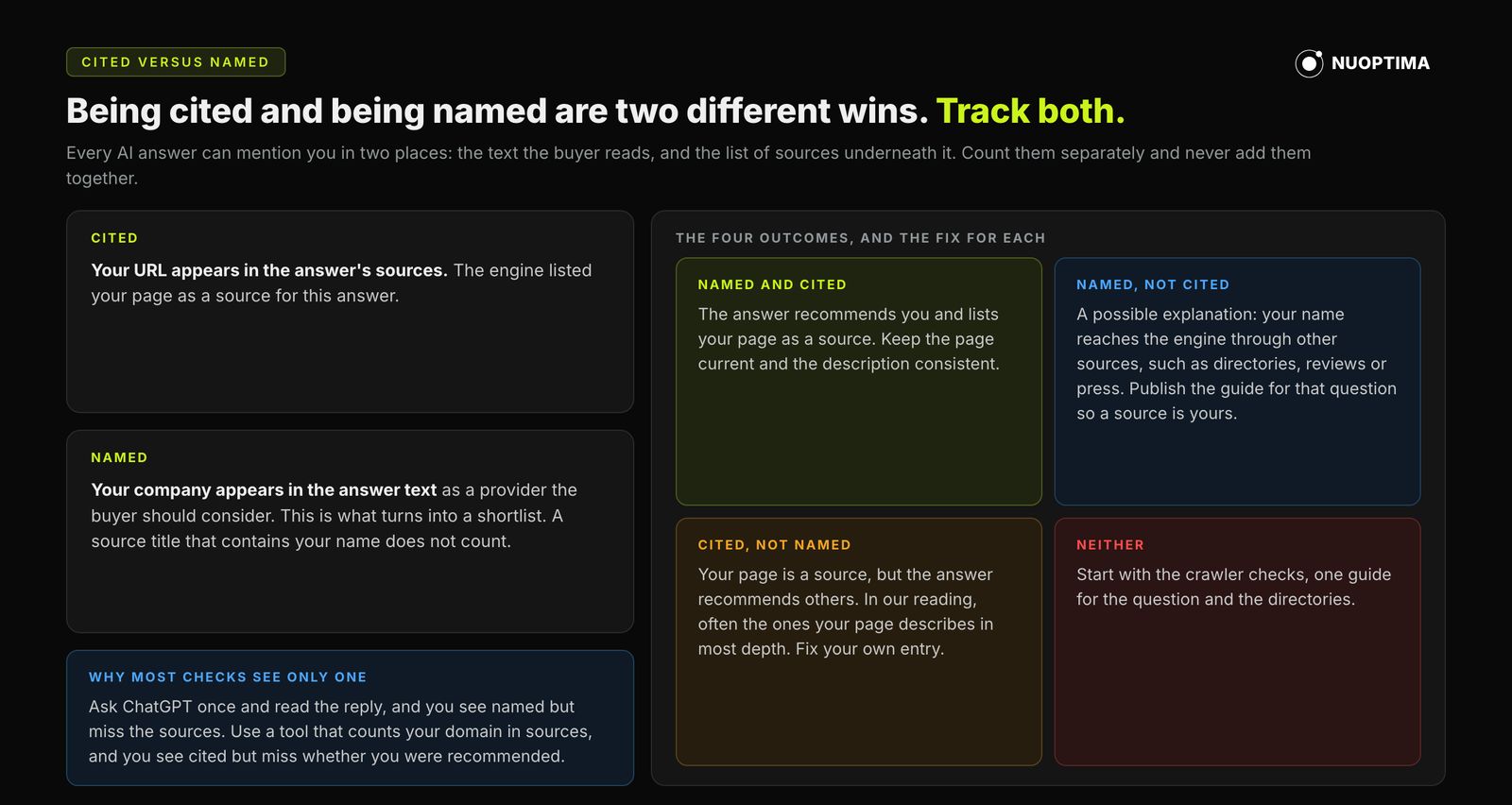
Above: the four outcomes when cited and named are scored separately, and the fix NUOPTIMA runs for each.
Named but not cited can mean your name reaches the engine through directories, reviews or press, so you publish your own guide for that question. Cited but not named means the answer recommends others, in our reading often the providers your page describes in most depth, so you rewrite your own entry. Neither starts with crawler access. Cortavo's site is static, so crawlers get the full page without running scripts, and it passes all six AI crawler checks we use.
In SourceRank's study the most-cited site was clutch.co, a directory, in 11 of the 41 answers with sources. Technologymatch.com came next with 9, and cloudtango.net, an MSP directory, matched cortavo.com's count. So we claim those profiles, give each the same one-sentence description the site uses, and ask clients for reviews in the buyer's words: team size, city, what they switched from.
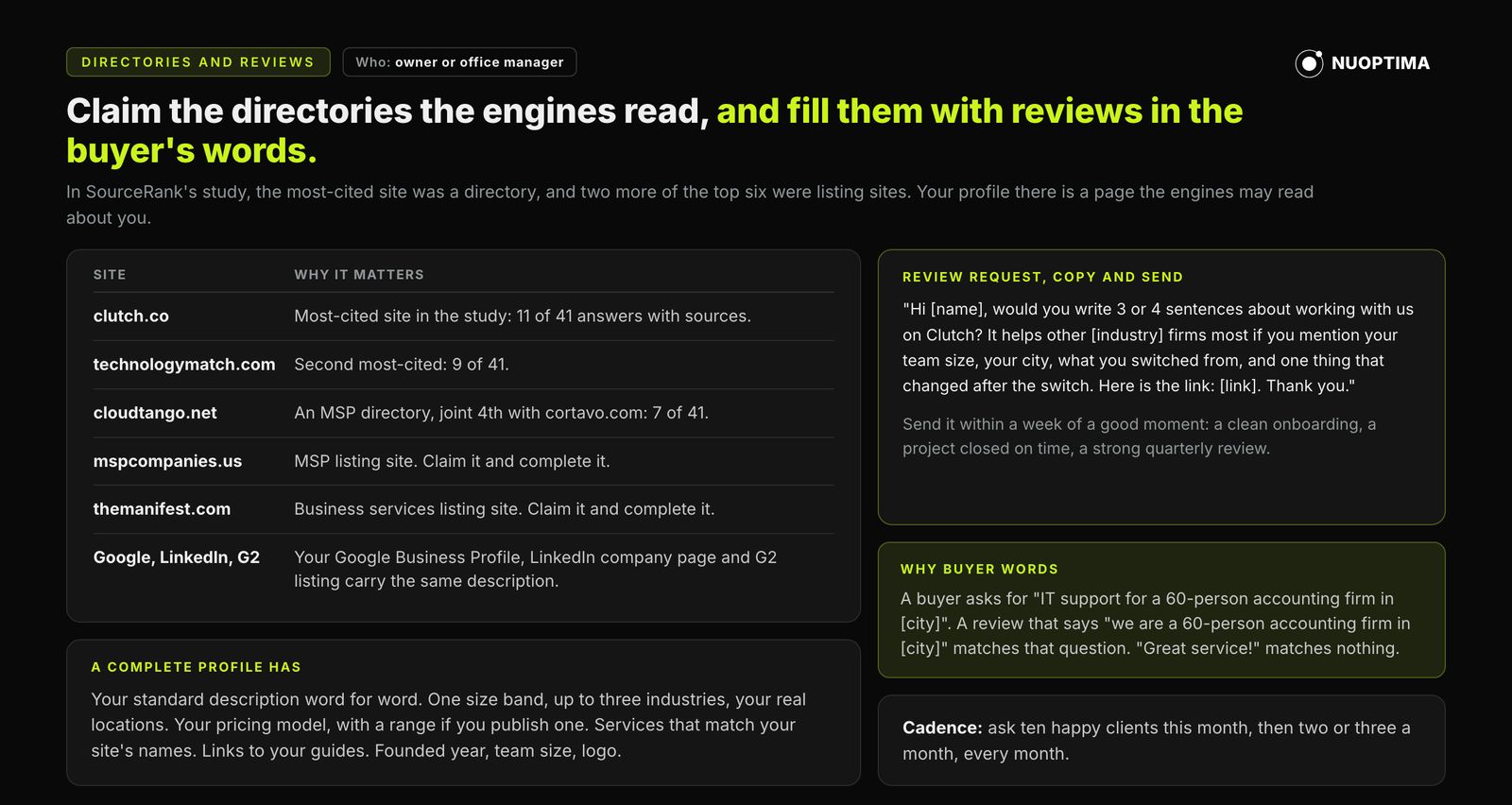
Above: the directories cited most in SourceRank's October 2026 study, other listing sites worth claiming, and what to put on each profile.
My view: owned facts are half the job. The other half is the list pages and mentions on sites you don't own, and a directory profile is the one of those you can fill in yourself.
How we measure AI citations and AI referrals: fixed buyer questions and an AI tag in the CRM
Google's Search Console help says an AI Overview takes a single position in the results, and every link inside it is given that same position. A click on one of those links counts as a click, and Google's AI features documentation adds that this traffic sits inside the overall "Web" search type. So the position cannot show whether you were the cited link or which firm the answer named, and Search Console covers Google only.
Cortavo's answer was a fixed prompt set: the same buyer questions, asked of ChatGPT, Gemini, Claude and Perplexity every month, with citations counted each time. The three published example prompts are "who are the best managed IT providers", "which IT support company should I choose" and "what's a reliable MSP near me". That is a different list from the keywords that bring signed contracts, and in my view an MSP needs both. When my agency runs this check for an MSP that has not done the work, the usual picture is that it gets named only when the prompt contains its name.
The second half sat in Cortavo's CRM. Search leads were tagged at source in HubSpot and Salesforce as "Search - Organic" or "Referral - AI". In December 2025 the "Referral - AI" source appeared, and it recurred every month through the case study's August 2026 update. By my calculation that is month 8 of the engagement, counting May 2025 as month 1. NUOPTIMA reads the timing as "direct evidence that AI-answer visibility converts to pipeline". That is its inference; no test isolates it.
What Cortavo's record does not show: no published count of AI-referred leads, and nothing on what became of them. Contracted sales are reported for organic and AI search together, not split. Not published is not the same as zero. If you set this up, count AI-referred leads and what they close for from month one.
This month: ask ChatGPT and Google your buyers' questions and log the answers
- Write down three to five questions your buyers would ask and put each one to ChatGPT and to Google. Log the date, the firms each answer names and the pages it cites. Ask the same questions next month.
- If the cited pages are list articles about providers in your area, check whether you are on them and whether your own site publishes one.
- Ask whoever runs your website to confirm that robots.txt allows OAI-SearchBot.
- Open the lead-source field in your CRM and confirm it has a value for AI referrals, separate from organic search.
If you want this run for your MSP, this is how I work as an SEO consultant for MSPs.