An agency sends you a keyword list for your MSP. Most of it is head terms for managed information technology (IT) services: broad searches with no city, industry or price, the "managed IT services" kind. When I searched Google for "keywords for MSP" on November 17, 2026, most of the ranking pages were keyword lists, and several of the older ones were built on head terms like that. None of it tells you which searches would ever sign a contract, or where the buyer sees the answer: Google's ordinary results, the map listings, or an AI assistant.
My answer is a judgment, and the rest of this piece shows its basis. The searches closest to a signed contract name what the buyer wants to buy: a service in a city, a service for an industry, a cost, a comparison, a migration. The intent is the same in organic, local and AI search; what answers it changes: a page on your site, your Google Business Profile, or the lists an assistant has read, on your site and on other people's.
The limit belongs up front too. Cortavo's published customer relationship management (CRM) record shows organic search produced signed clients. It does not say which keyword produced which client. The last section covers the field I would add to close that gap.
For ten years I worked in investment banking and private equity, pricing businesses from the buyer's side. Then I built what became the largest cannabidiol (CBD) marketplace in the UK, as the first step toward a leading European cannabis business, and raised $4M+ for it. Google, Facebook, TikTok and Instagram all ban CBD advertising, so search had to carry the whole business. Brands asked us to do the same for them, and in 2020 that became NUOPTIMA, the agency I founded. When the CBD market collapsed, I shut the marketplace and put everything into the agency. Today it is a team of 25+ specialists, and after years with brands in other industries it works only with MSPs. It took Silver for Best Use of Search, B2B (SEO) at the US Search Awards 2026, for the Cortavo case study, was a finalist at The Drum Awards for Search 2023, was shortlisted in the same category at the UK Search Awards 2023 for Microminder Cyber Security, and won it at the UK Search Awards 2022.
Cortavo, an MSP, is the first worked example, and NUOPTIMA did its search work. I'm also Cortavo's CRO, so I saw both the SEO work and the sales pipeline it fed. Microminder Cyber Security is the second. The definition of a buyer-intent search, and the order to build a site in, are in the guide to SEO for MSPs. This piece ranks the searches themselves.
What Cortavo put first, and the head term it went around
In May 2025 Cortavo's average Google position was 42.6. NUOPTIMA's assessment was that "managed IT services" belonged to incumbents with far stronger links pointing at their sites, and that fighting them head-on "would have burned the budget for nothing." That was a read of Cortavo's starting point, not a test anyone ran.
So the program went around the bare national term without ignoring it. Cortavo targeted the city version, "managed IT services in [city]", and built a managed IT services page for Dallas. NUOPTIMA's published Cortavo case study states the strategy as putting "high-intent, low-volume bottom-of-funnel terms (service, pricing, comparison, migration and location queries) over broad, cheap traffic." Bottom of the funnel means the stage the case calls vendor selection: the buyer has decided to buy and is choosing the firm. The flagship niche, migration off legacy IT and HCL Domino, was small, and in the case's words "Volume could never be the goal; value per visit had to be."
The step I would copy first came in months one to three: NUOPTIMA mapped every target term to a funnel stage and a buying-committee role (the owner or finance chief, the IT manager, and the others who weigh in) before a word was written. The full Cortavo case study has the targets and the phases.
MSP keyword types, ordered from closest to a contract to furthest
The stage labels below are the case's own, with one exception: the case does not place industry searches in a stage, and I put them in the bottom stage because Cortavo built its industry pages alongside its city pages. The order within each stage, and how close each type sits to a contract, are my judgment.
| Stage (the case's label) | Keyword type | Cortavo's published example | What Cortavo built for it |
|---|---|---|---|
| Vendor selection (bottom) | Service plus city | "managed IT services in [city]" | Managed IT guides for Dallas, Houston and Atlanta |
| Vendor selection (bottom), my placement | Service plus industry | None published; manufacturing, construction, law firms, cloud | Same template family as the city pages |
| Vendor selection (bottom) | Migration | "HCL Domino migration services" | Migration guides for the legacy IT niche |
| Vendor selection (bottom) | Comparison and list searches | "best MSP for small business" | Comparison and list content, months 10 to 12 |
| Vendor selection (bottom) | Cost and pricing | No example published | Named as a target, no result published |
| Solution (middle) | Solution category | "managed IT services", "co-managed IT", "outsourced IT department" | Content; the bare national term not fought head-on |
| Problem-aware (top) | Problem question | "is our IT actually secure", "shadow-AI risk" | Content for this stage |
I would build service plus city first: the search names what the buyer wants and where. Industry pages come next; Cortavo built them as a grid of three cities by four industries. Migration sits third only because it needs a niche the way Cortavo had Domino. If you have one, it moves up.
Comparison and list searches came late at Cortavo. I rank them below city and industry pages because a buyer reading a list is still choosing between firms, though lists matter more in AI search. Cost searches have the least behind them: the case names pricing queries as a target and publishes no example or result. My view is that a cost search needs a plain pricing page to land on. Whether to publish it is covered in whether to put pricing on your website.
Cortavo built middle and top-stage content too; the bottom stage came first. One type stays out of the table: IT how-to searches, the kind an end user types when something breaks. Cortavo published no figure on them. In my view they bring people who want a fix, not a contract, and I would not build for them while any vendor-selection page is missing.
Microminder: 105 service pages before a blog, on a brand-new domain
Microminder Cyber Security is the cybersecurity arm of a 40-year-old technology group. When NUOPTIMA started in August 2022, its domain was brand new and ranked for 3 keywords.
So the keyword plan was the page plan. NUOPTIMA built 105 service-specific landing pages before any blog program, each technical page edited in five stages, the last by Microminder's own security experts. NUOPTIMA's published case study puts the result at 4,503 ranking keywords in 23 months, 125 top-three positions by July 2024, and roughly 20 quality leads a month. Those are totals; they do not say which page brought which lead.
Cortavo had a site that ranked, just far from page one; Microminder had nothing. Both built the pages for buying searches first. In my view an MSP in business for years usually already holds the hardest asset, links from other sites. What it lacks is a page for each search a buyer types.
How keyword choice changes across organic, local and AI search
My view is to work all three search surfaces together and judge each one on signed contracts in the CRM.
| Surface | Where the buyer sees the answer | What I would build first | How it shows up in the CRM |
|---|---|---|---|
| Organic search | Google's ordinary results | One page per bottom-stage keyword type | Organic source tag, plus a landing-page field, if you add one |
| Local search | The map listings, driven by your Google Business Profile | A complete profile per office, real client reviews, site pages backing each listing | Calls from the listing, logged by call tracking with their own source value |
| AI search | ChatGPT, Gemini and Google's AI answers | Best-of and comparison pages, and the same facts about you everywhere | An AI referral tag, as Cortavo used |
Google's own help page on local ranking names distance, how far the business is from the person searching, as one of the main factors in local results. So in my reading, a map listing is tied to where you have an office; an ordinary results page is not. My view is that an MSP can rank for managed IT in cities where it has no office and serve clients there through a field-services marketplace. I would rank wide first, so the site starts collecting rankings and clicks, then put the depth into the locations you serve. Map listings and reviews stay where you have clients. Local leaders are often less dominant than they look.
For the listings, the simplest fix I know is a Google Business Profile filled in properly (photos, services, the words buyers search with, regular posts, a steady process for asking real clients for reviews), and in my view links pointed at the listings help too. Cortavo's published case reports nothing on map listings, so this is my view, not Cortavo's record.
AI search changes the phrasing more than the intent. The case's reasoning for Cortavo's list content was that "listicles mirror how AI prompts are phrased: 'best X', 'top Y', 'recommended Z'." My view is that the list on your own site should name you first, and the same kind of list on other sites does more. Nobody can promise a citation; how AI search changes MSP SEO covers what moves it.
What Cortavo's published CRM record attributes, and what it does not
Cortavo tagged every lead and contract at source in HubSpot and Salesforce, "Search - Organic" or "Referral - AI", and followed each from marketing qualified lead (MQL), an inquiry judged ready for sales, to a signed contract, counting only contracts signed after the work began. From May 2025 to May 2026, that record shows 8 new clients from organic search against a target of 5, and 75 organic-sourced MQLs.
The published tags name the channel, not the keyword or page, and the case ranks pages by visits only, so it does not say which keyword types signed those 8. The order in the stage table is my judgment, informed by what Cortavo chose to target and by the channel result.
What the published case does show is the footprint changing shape. From January to June 2026, third-party ranking data for the US put Cortavo's page-one keywords (searches where its pages appeared on Google's first page) at 120 rising to 246, and its top-three keywords at 20 rising to 44. By my calculation from the same data, page-one terms went from about 39% of everything Cortavo ranked for to about 54%.
I read keyword counts as a progress signal and contracts by source tag as the result. The case's own takeaway is blunter: "Set revenue targets, not traffic targets."
Five buyer guide types, one buyer question per page
NUOPTIMA's AI search playbook for MSPs turns the bottom-stage types above into five kinds of buyer guide: an industry guide, a city guide, a buying-decision page, a "top MSPs" comparison and a pricing explainer. Each answers one question a buyer types word for word, such as "who handles IT for law firms like ours?" or "what does managed IT cost per user?", and each is a list or a decision an engine can quote.
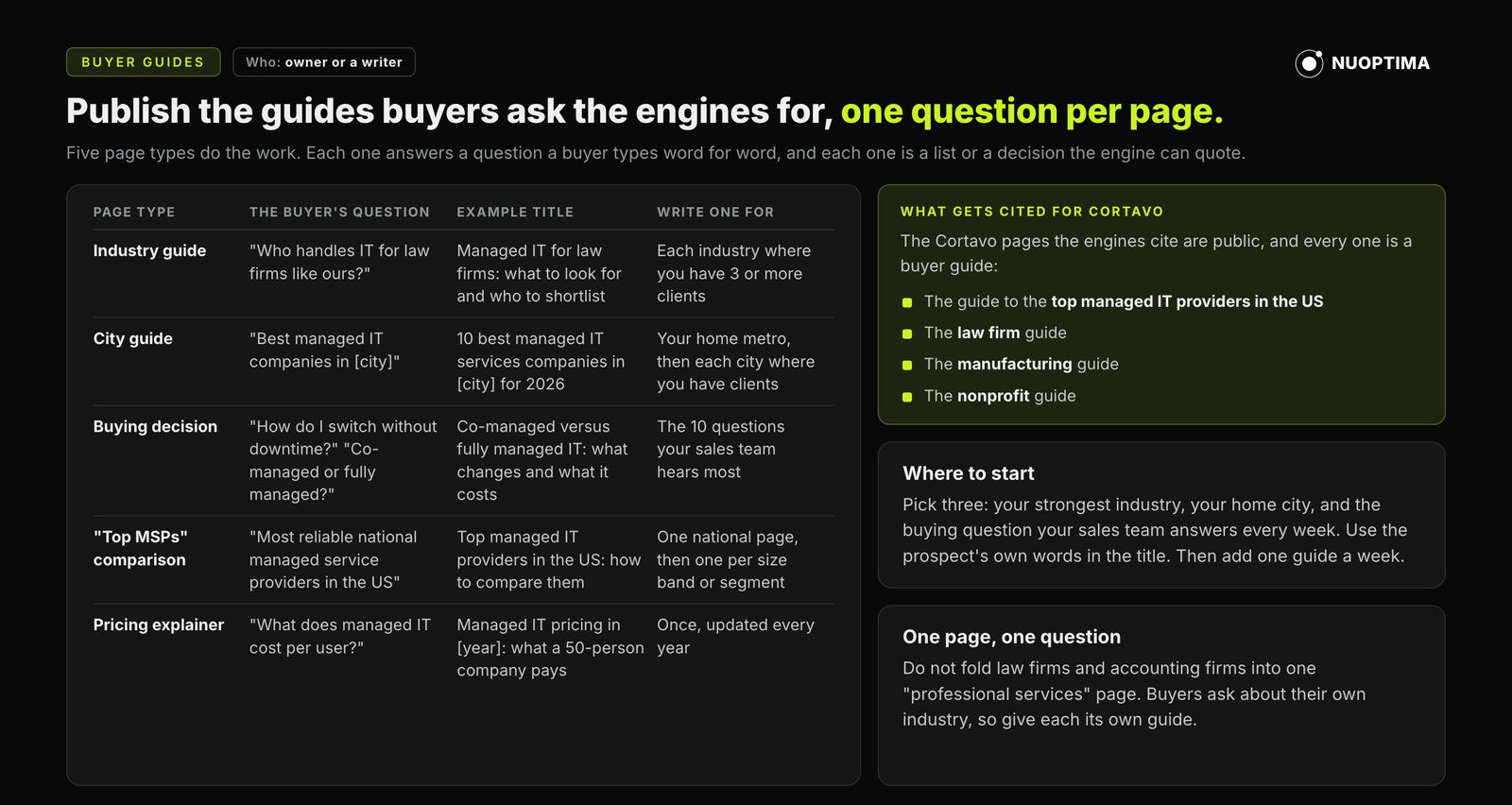
Above: the five buyer guide types, the question each one answers, and the Cortavo guides the engines cite.
The Cortavo pages AI engines cite are buyer guides, not service pages: the guide to the top managed IT providers in the US, and the law firm, manufacturing and nonprofit guides. The playbook's rule is one question per page, so law firms and accounting firms each get their own guide rather than sharing a "professional services" page.
In my judgment a keyword type with no page of its own cannot be won, whatever the list says. Start with three guides: your strongest industry, your home city and the buying question your sales team answers every week. Check the list against the pages you have before anyone researches a new term.
How to check your keyword choice in your own CRM this month
Cortavo's published channel tags answer whether search paid, not which page types did. Here is how I would get both:
- Confirm every new lead carries a source tag (the field naming its channel), with separate values for organic search, AI referral and the map listing. Listing calls need call tracking that writes into the CRM, or they arrive untagged.
- Add a landing-page field to the lead record: the first page the lead saw on your site. This is my addition, not something the case says Cortavo did. Send one test lead from a service page and check that the tag and the page both arrive.
- Sort your keyword list into the three stages, then by surface. Map every vendor-selection term to the one page meant to win it, as Cortavo did before writing. A term with no page goes on the build list. A city you cannot serve, directly or through a field partner, comes off.
- After a quarter, pull closed-won deals (signed contracts) by source tag and landing page, and see which page types they started on. Expect a small number: one MSP, Cortavo, signed 8 organic clients in a year; by my arithmetic a quarter at that pace holds about two. Read it as a direction and keep the field running.
This month, do the first two steps and send the test lead. The sort can wait a week. The field cannot wait, because a lead that arrives without it cannot be traced back to a page later.
If you want this run for your MSP, this is how I work as an SEO consultant for MSPs.